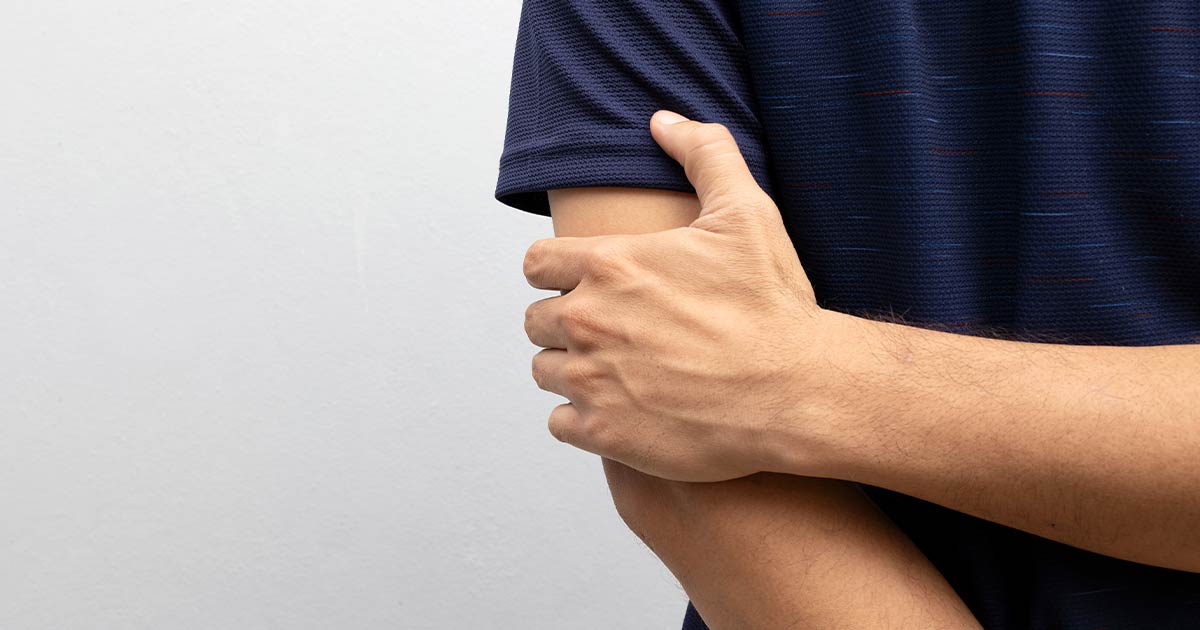
The biceps muscle plays a crucial role in elbow flexion (bending) and forearm supination (palm-up rotation). A rupture significantly weakens these functions, affecting both daily activities and athletic performance.
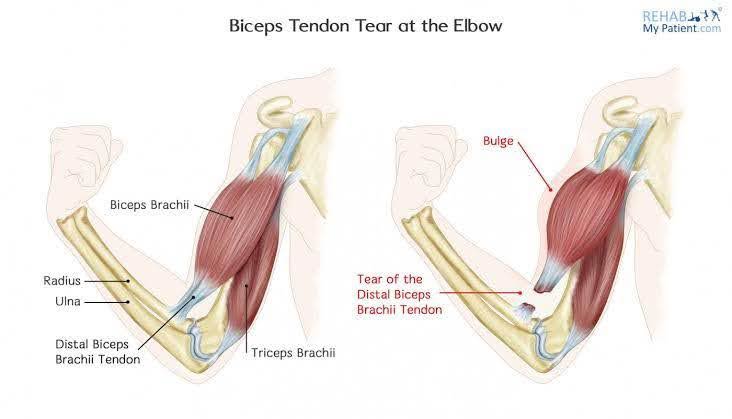
This injury involves a tear of the tendon where the biceps muscle attaches to the bone in the forearm (the radius).
Causes
- Sudden Force: The most common cause is a forceful contraction of the biceps muscle against resistance.
- Examples: Lifting heavy objects, throwing, or certain weightlifting exercises (such as eccentric biceps curls).
- Degenerative Changes: Over time, the tendon can weaken due to age-related wear and tear or repetitive stress, making it more susceptible to rupture.
- บางและเสี่ยงต่อการฉีกขาด
Symptoms
- Immediate Pain: Intense pain at the front of the elbow, often described as a “pop” or “snap.”
- Rapid Swelling and Bruising: Inflammation around the elbow joint.
- Weakness: Difficulty bending the elbow, turning the forearm (supination and pronation), and lifting objects.
- Visible Deformity: In some cases, the biceps muscle may “ball up” higher in the arm. This is also referred to as the “Reverse Popeye sign” (in contrast to the original Popeye sign, which refers to the biceps muscle “balling down” lower in the arm in cases of proximal biceps tendon rupture).

Diagnosis
- Physical Examination: Your doctor will assess your range of motion, strength, and tenderness, utilizing specific tests such as the Hook Test and Supination-Pronation Test.
- Imaging Studies:
- Ultrasound: Can visualize the torn tendon and surrounding soft tissues.
- MRI: Provides more detailed images, especially when surgical repair is considered.
Treatment recommendation by Dr. Pratya Jaratjitwilai
For a complete distal biceps tendon rupture, after initial treatment involving rest, cold compression, and pain management, I typically recommend surgical treatment, except in older adults or those with low physical demands.
I perform a two-incision distal biceps tendon repair (Modified Morrey technique). This involves a split incision at the front of the elbow to identify and suture the tendon, and another incision at the side of the elbow where the tendon attaches to the radial tuberosity.
The advantages of this technique include:
- Relatively minimally invasive
- Lower risk of nerve complications
- Better restoration of anatomical footprint repair
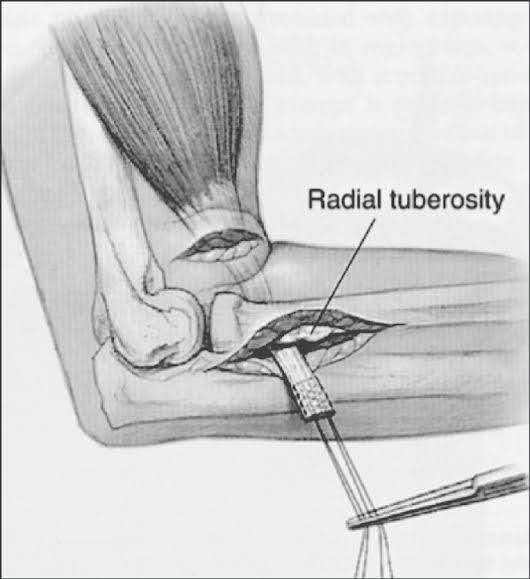
The original technique, tranosseous repair or the “bone bridge technique,” involves placing sutures from the tendon into drilled holes near the attachment area.
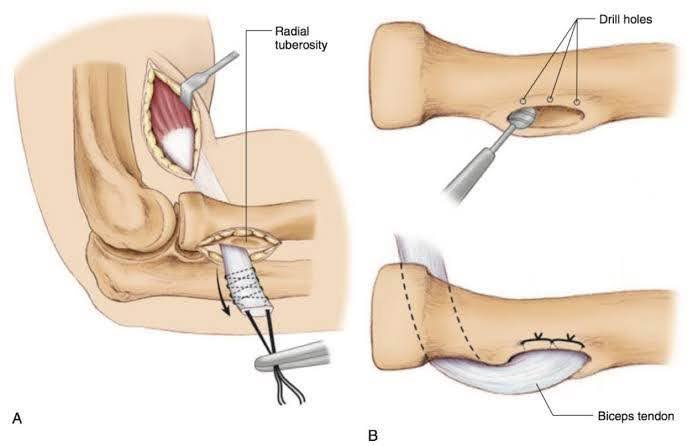
In addition to this fixation technique, I reinforce the repair with a cortical suture button to ensure the security of the fixation. My colleagues and I described this technique in the Arthroscopy Techniques journal, with the publication scheduled for February 2025.